The New Center of Hospital Care

Since the days of Hippocrates, nurses have been at the frontline of the hospital care model. RSP’s Melissa Emerson AIA touches on a few design considerations that can make a nurse’s job easier and less stressful.
The past decade has brought disruptive and transformative change to the healthcare industry. From the operational day-to-day of an urban ED to the labyrinthine regulatory landscape, from waves of new technology to the emergence of telemedicine, no aspect of the healthcare ecosystem has gone untouched. The COVID-19 pandemic only accelerated that change, leaving many health systems nervous about whatever comes next.
But through all of this chaos, one thing remains constant: The fundamental role and nature of nursing.
The three million nurses working today, the great bulwark of our healthcare system, are typically the caregiver in a clinical setting with the most direct and persistent patient interactions. Ranked the most trusted profession in America for the last 25 years, nurses play a pivotal role across the entire health equation—nurses administer primary, acute, and specialty care; they educate patients and families; advocate for the vulnerable; and stand at the frontline of disease prevention.
And yet…
A nursing shortage persists, filled with data dominos that only topple into other bleak statistics, including elevated burnout rates, issues of pay equity, and, ultimately, respect. The American Nurses Association (ANA) reports that nearly 20% of new graduate nurses leave the profession within the first year, citing stressful working conditions and understaffed locations. The ANA also found that nearly 70% of nurses under 25 experience debilitating at-work anxiety, depression, and reduced performance.
Well, what can be done? Turns out the answer, or at least part of it, may come back to design.
Good Design Makes a Nurse’s Job Easier
What if design made a nurse’s job easier, more efficient, and, at the same time, improved patient outcomes? What if a relatively simple adjustment in space drove us to rethink how practitioners deliver patient care? What if we could lower the cost of operations and improve the efficiency of a nurses work station? Reduce travel distances to the bedside. Provide pleasant, regenerative break areas or access to natural light, proven factors that improve employee happiness, wellness and productivity.
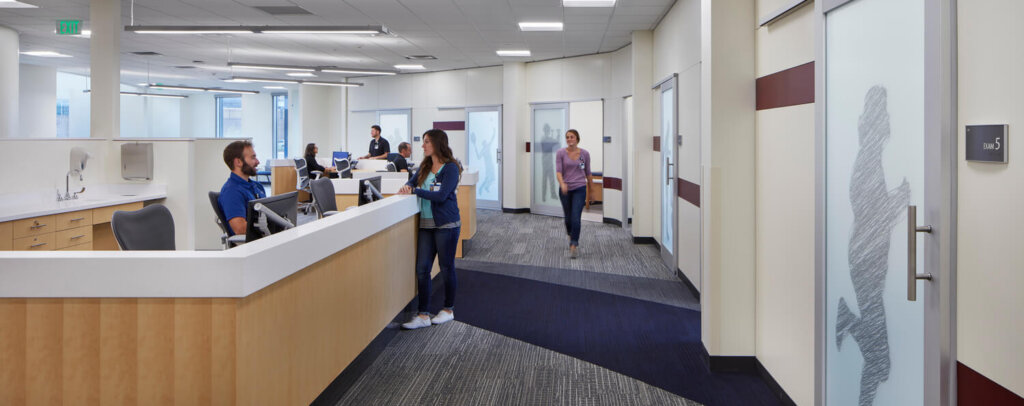
Just as our workplace clients have explored open plans and hybrid workspaces, over the last several years we’ve begun to rely on evidenced-based design and Lean techniques to question traditional healthcare layouts and floorplans, especially when it comes to the role and position of a nurse within the overall equation.
The traditional race-track model, for example, which has served the industry for decades, has begrudgingly given way to new approaches. The so-called open core model, which distributes care team work areas along corridors, has sprung new ways of thinking about a nurse’s daily routine and clinical paths.
The Tech and the Tele
The rise of telemedicine, one of the more impactful consequences of the COVID-19 pandemic, has transformed hospital design from centralized, high-density inpatient facilities toward flexible, tech-enabled, and decentralized environments. Large, suburban acute care facilities are giving way to smaller, ambulatory care facilities positioned closer to the communities they serve. This is a significant shift in the provision of care, and it has major implications in how we design for nursing functions.
Traditional exam rooms are becoming more hybrid spaces equipped with cameras, monitors, and flexible lighting to facilitate both in-person and virtual care. These spaces often require acoustic treatments specifically for virtual consultations, tele-meetings, or group chats. On the desktop, up-to-date computer systems, electronic health records (EHR) platforms, and communication tools all compete for space, and attention, creating what can easily become visual chaos and clutter.
The attractiveness of the technology integration, and the intense display of data and information, often means that a floor nurse may stare into monitors most of their shift, contributing to physical strain, mental fatigue, and stress from over-connection. It is little wonder that, in conversations with nurses about how better design can help reduce burnout, the most consistent asks are for a place for human connection, natural light, or views of the outdoors.
As a result, we have started to re-think these spaces, placing greater emphasis on how nurses interact with their physical environment. This goes beyond ergonomics, shifting from merely preventing injury to focusing on the cognitive, emotional, and environmental factors that enhance a nurse’s day-to-day experience.
When is a Breakroom Not Just a Breakroom
In the past, traditional breakrooms were utilitarian with minimal design consideration, tucked into a forgotten corner of the floor and offering a microwave, a few sad tables and chairs, and a vending machine.
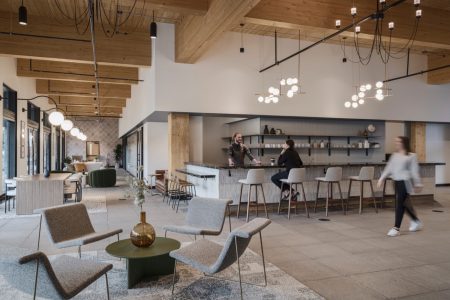
Drawing inspiration from our corporate interiors work, today’s breakrooms have evolved into multi-functional hubs that prioritize employee wellness. Because nurses are notorious for putting patients first, the goal is to create an environment that puts them at the center. A space that promotes self-care, calm, respite, and maybe a bit of escape to breathe and allow their nervous system to relax.
Security
While national crime rates are trending down, the prevalence and sheer randomness of violence in healthcare settings is trending upward. Behavioral health issues are rising sharply in the U.S., especially among the youth, with diagnoses surging 40% between 2019 and 2023. COVID-19 significantly accelerated this, leading to increased rates of depression, anxiety, and substance use. At the same time, the incidence of violence in healthcare settings has also significantly increased, with rising rates of assault, homicide, suicide, and firearm violence.
Nurses, of course, stand at the front line.
Given these trends, it is no mystery what the implications are for healthcare designers. We have begun looking closely at the integration of physical security features, like secure, lockable spaces, clear sight lines and visibility, discreet CCTV surveillance, and specialized patient observation are becoming baseline requirements. The trick, of course, is integrating these elements into an environment that reduces stress, promotes well-being, and encourages healing. A secure place that does not feel like a fortress.
Ask a Nurse
All of this has altered our design process, which has become more inclusive and collaborative, especially with the clinicians and practitioners who will end up using the space. Along with their role in the entire continuum of patient care, nurses have in-depth understanding of hospital workflow, staffing, facility processes and cost-related issues that tie into every area of design. Tapping into their expertise early and often is critical in our work as designers.
ABOUT THE AUTHORS