Intersections: Architecture that Supports the Organ Donation Process
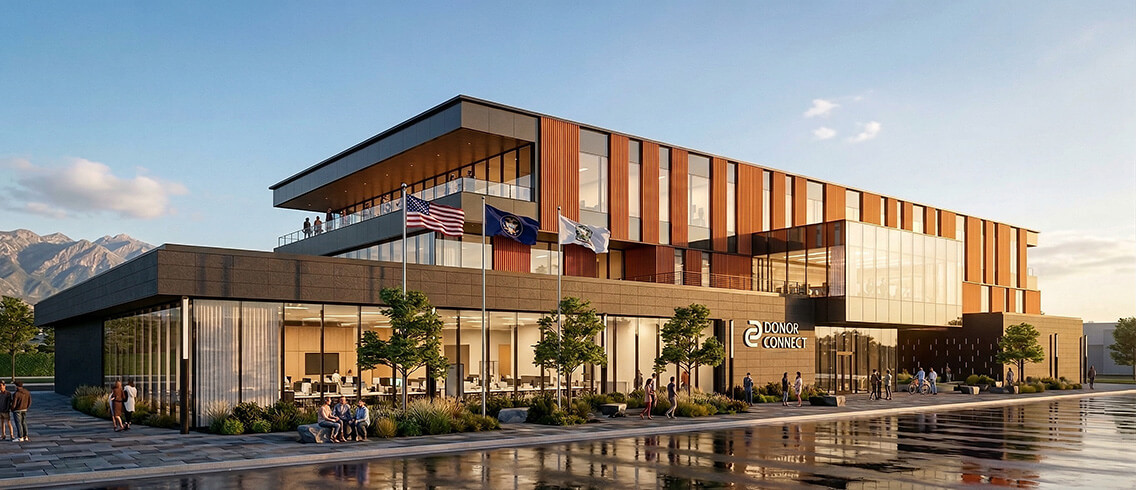
ABOVE: RSP is partnering with Donor Connect in Utah. Their new headquarters includes a community center and a formal memorial plaza for families and donor recognition. Inspired by the remarkable mountain basin, the design uses local stone, terracotta and other natural materials to create a strong regional context.
Organ and tissue donation provides a lifesaving and healing gift to someone in need, often turning tragedy into hope and comfort. There are 55 organ procurement organizations (OPOs) nation-wide dedicated to facilitating the process of donation, requiring a high degree of compassion, skill and care for donors and their families. RSP’s Basem Hamami CSI, CDT, CCCA, and Derek McCallum AIA, NCARB, CID, LEED AP, have worked together to design spaces for organ procurement organizations (OPOs) and have learned to lean into the poetry and pragmatism.
OPOs are non-profit, federally regulated entities responsible for recovering organs and tissue for transplantation. OPOs work directly with hospitals to facilitate the donation process, from identifying potential donors to managing donor care and transporting organs to recipients. OPO’s also provide support to donor families and help educate the public about the process and how to register to become an organ donor. Each OPO covers a defined geography and is regulated by federal agencies.
The Role of OPOs in the Organ Donation Process
Organ donation is a complex, often emotional journey that by its very nature must happen quickly, efficiently, and with the utmost dignity; and OPOs are at the center of that process. OPO teams work with hospitals to identify patients who may be potential donors. They evaluate donor suitability and organ viability, promote donor registration, and provide compassionate communication and support to families to facilitate the discussion of donation. They work closely with the Organ Procurement and Transplantation Network (OPTN) to facilitate fair, medical‑based organ allocation across the US, ensuring donated organs are matched appropriately to patients in need.
The Human Impact of Organ Donation
While OPOs generally operate in the background of any clinical event, their overarching impact can’t be overstated. They are often the reason the gift of life that a donation represents is fulfilled, offering a grieving family hope at what can be one of the saddest, most trying times of their life. From our experience, we know that these remarkable organizations are most often led by extraordinary professionals who are passionately focused on their mission.
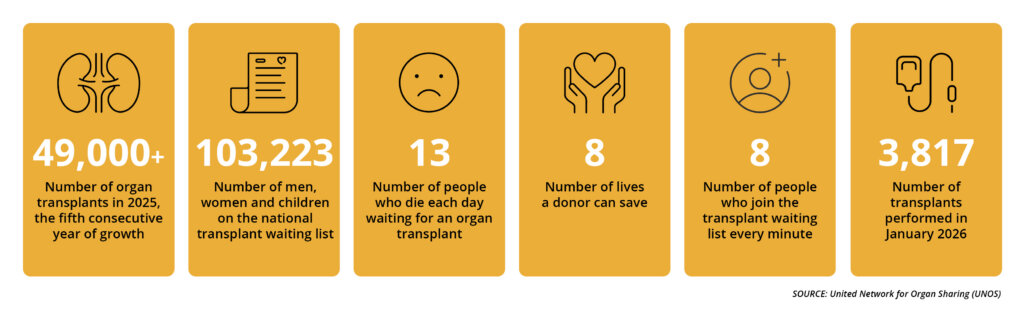
The data underscore the mission:
The OPOs are the fulcrum of the country’s organ donation system, and, over the last few years, RSP has developed a particular expertise in designing facilities for these unique mission-driven organizations. We have had the great honor of being involved in most of this work and have come away better architects, better people and more convinced of the extraordinary value OPOs—and the entire organ donor community—bring to our world.
Designed by Metaphor
Because of their commitment to their mission, OPOs are compassionate clients which, in our view, makes them ideal clients. Their work resides at the intersection of life and death, it encompasses both sadness and hope; so it’s natural to see a certain poetry that informs the design of these facilities.
We’ve found that metaphor is an essential design tool in shaping facilities for OPOs, where clinical precision intersects with profound human emotion. In these environments, architecture holds complexity: the urgency of lifesaving work, the vulnerability of donor families, and the quiet heroism of the practitioners and professionals who navigate both.
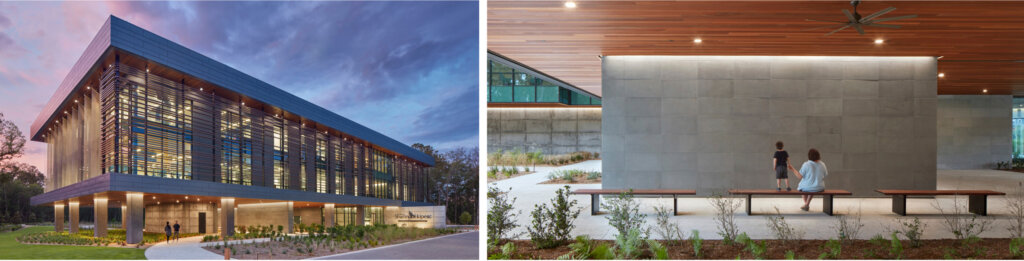
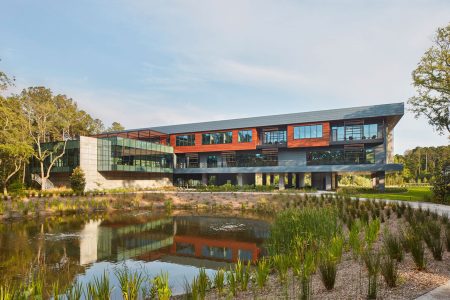
At We Are Sharing Hope SC, the landscape flows below the building, creating a contemplative space that honors those who have donated the gift of life. | Photos © Mark Herboth Photography
Metaphor helps translate these intangible forces into spatial experiences that comfort, inspire, and clarify purpose. When leveraged with intention, metaphor can elevate an OPO from a purely technical workplace into a place of purpose and meaning—one that honors the extraordinary gift of donation while supporting the people who make it possible.
Design metaphors such as “light as hope” or “nature as renewal” create legible emotional cues throughout the facility. Light-filled arrival spaces signal welcome and dignity. Transitional zones can mirror the donor-to-recipient pathway, reinforcing the idea that every step in the building, every touchpoint contributes to saving lives. Materials, textures, and rhythms inspired by growth, resilience, or continuity help ground staff during intense, high-stakes work.
Ultimately, as it does in poetry, metaphor strengthens the narrative coherence of the design, allowing architecture to communicate compassion, purpose, and respect—quietly reinforcing the mission: honoring life, supporting families, and enabling the possibility of tomorrow.
Driven by Mission
For all the poetry, though, there is also a pragmatism to these facilities that is no less vital to their success. In the form-follows-function world of architecture, our job has been to make sure we never lose sight of the functional part of that equation, but rather use it to advance the mission.
Like all complex buildings, OPO facilities are best understood by the requisite elements and how those pieces come together as a greater whole. We like to think of them as a series of choreographed experiences that place the selfless act of donation at the center of the design equation, as well as the human dignity such an act deserves. If we start there, we’ve found that the rest gets easier.
Site Selection and Operational Efficiency
Because everything about the architecture reinforces efficiency, ease of use, and human dignity, we want each element to contribute to these goals, beginning with site selection, building configuration, and massing. By exploring and analyzing a site’s assets, opportunities, and constraints, we look for insights into how we can ultimately optimize user experience.
Identifying all potential users and gaining insight into their state of mind is the first step in defining the unique pathways and experiences we must create. These key groups—the donor’s family, the clinical team, and the operational support—arrive with a distinct purpose and emotional profile. The design then becomes a quiet choreography, using a series of architectural cues and prompts to gently guide the way. Understanding and managing these paths is one of the great joys of our work.
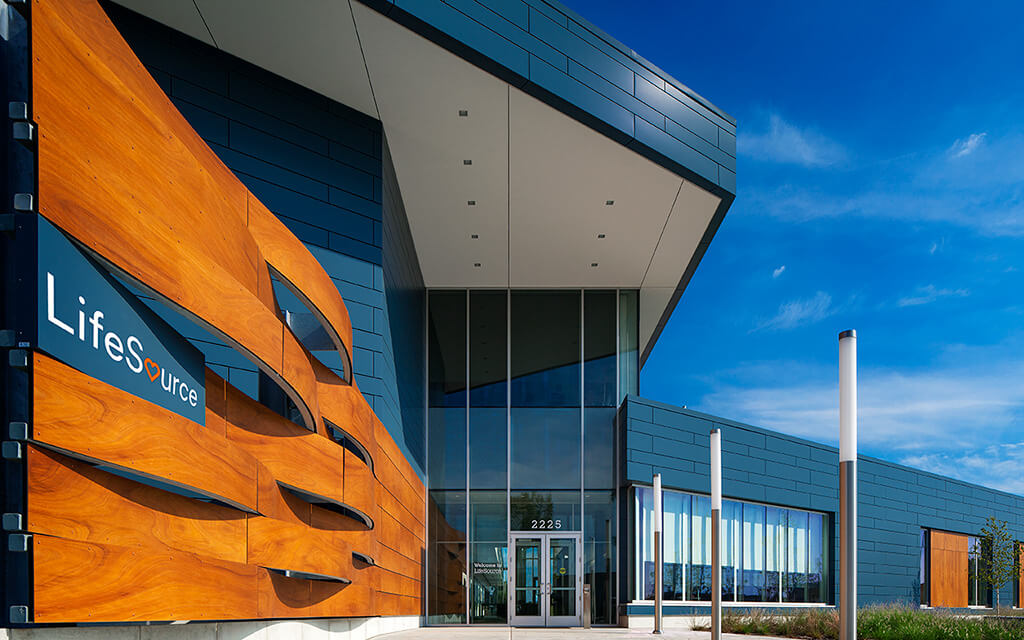
At LifeSource’s headquarters in Minneapolis, RSP designed a building and garden that takes it inspiration from the Mississippi River. The dual-wing structure blends engaging spaces for work and reflection, including a memorial garden that overlooks the river and features a granite wall inscribed with the names of donors. | Photo © Peter J. Sieger
Time, Access, and Life-Saving Adjacencies
In every donor event, time is of the essence. That efficiency starts with site selection. Site criteria must balance access and proximity with the more conventional concerns of architecture and real estate. Access to highways and airports is important but so is the proximity to major medical facilities, health systems, and other partners. We live in a world where any object, however precious, can be delivered to any destination within hours, but when we are considering OPO sites, these adjacencies are not just about convenience and operational efficiency but about life and death. Every second matters.
As with any building, massing, solar orientation, and site layout are important from a sustainability and energy perspective, but with these projects, we try to develop a parti that avoids a monolithic impression. We have found that breaking down massing and scale allows us to be more strategic in how the site and spaces are arranged, and how we can orient and inform visitors.
Circulation, Arrival, and the Visitor Experience
While location is always a prime concern on any project, we’ve come to understand that it’s internal and external circulation that are critical components of an OPO project. We have learned to keep that top of mind, taking a deeply intentional approach as we explore how design can inform the arrival sequence, the entrance experience, and a visitor’s journey from parking to destination.
OPO facilities are typically operated around the clock, 365 days a year. Because they are also buildings with off-grid operational capability, we try to avoid residential neighborhoods. Nevertheless, it is not uncommon for us to consider a scale and “front door” that feels comfortable in a dense suburb or along the edge of a city streetscape. Our goal is always to make the building, inside and out, approachable and human.
Integrating an OPO facility within its community unlocks various possibilities, with many OPOs viewing community outreach and education as central to their mission. To support this, we frequently incorporate a public-facing area suitable for gatherings, symposia, or meetings. We firmly believe that quality architecture should enable civic engagement and public interaction, and OPO facilities embody this principle with honesty and transparency.
Security, Life Safety, and Code Considerations
Simply put, we live in a volatile world, and this particular field demands a holistic sensitivity to every aspect of our work. To that end, we bring a delicate touch when factoring in security needs, including restricted access, secured parking, and specialized clinical spaces that can include bio-vestibules (air-locked, two-door systems) to maintain environmental control and independent air supplies.
From a code and life-safety standpoint, OPO facilities mix uses and users and require an experienced hand when it comes to reviews and jurisdictional approvals. As a matter of best practice, we always seek to develop an early relationship with the authorities having jurisdiction (AHJ) in order to best understand concerns and to increase their understanding of the special nature of these buildings and the unique issues they raise. To date, we have not encountered an issue that couldn’t be addressed with patience, perseverance, and solid technical knowledge.
Finally, we’ve learned not to underestimate the contribution biophilic design makes to the overall user experience, not just aesthetically speaking, but from a health and wellness perspective as well. We make a point of integrating natural lighting, sustainable materials, and organic forms whenever and wherever we can, even if those elements may be accompanied by their own share of technical challenges. Sunlight, indigenous plants and vegetation (living walls/roofs), organic materials (wood, stone), and water features go a long way to creating an environment that inspires, improves mental health, productivity, and well-being.
Architecture in Service of Life
At their core, OPO facilities exist to support one of the most selfless acts imaginable. The architecture must rise to that responsibility by balancing speed with care, precision with compassion, and technical rigor with humanity. When done well, these buildings quietly support donors, families, clinicians, and staff at moments that matter most. In that way, architecture becomes not just a backdrop to the organ donation process but an active participant in honoring life, dignity, and the profound impact of generosity.
Learn more about one of our OPO projects, We Are Sharing Hope SC, here:
ABOUT THE AUTHORS