A Net-Zero Building, Ten Years On
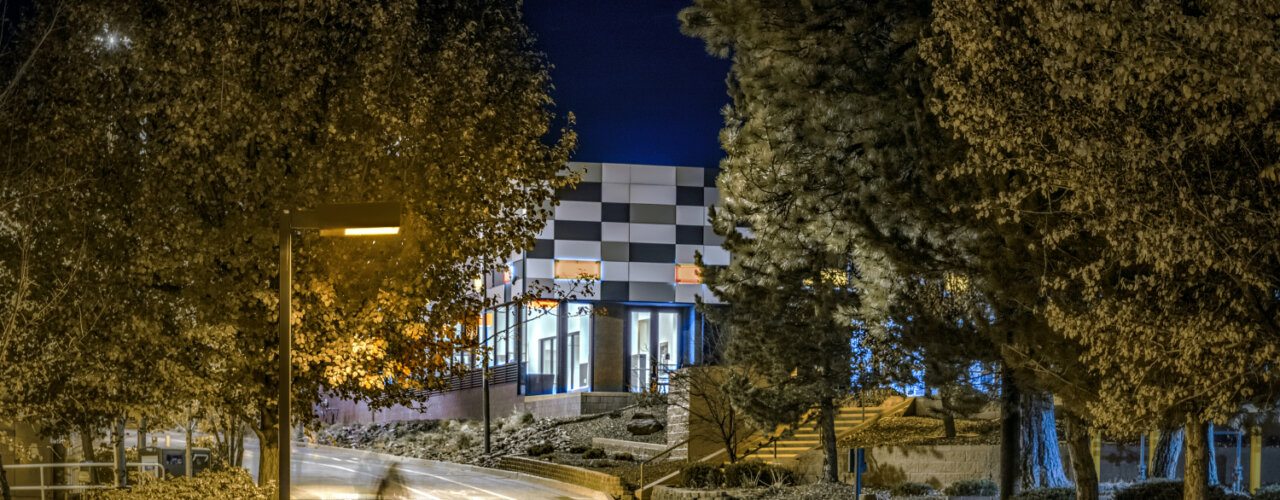
Northern Arizona University’s International Pavilion has spent a decade proving a quiet thesis: the most sustainable building is often the simplest one. Here’s what its data — and the people who run it — taught us. Jason Ploszaj and Linnea Brudenell re-visit one of RSP’s seminal projects.
Designed to be a net-zero site energy building, Northern Arizona University’s International Pavilion opened in 2015 as a certified LEED Platinum building — the kind of achievement that makes for a good ribbon-cutting. Ten years later, it has something rarer: a decade of operating data, real world experience, and candid lessons from the people who keep it running. We sat down recently with the NAU team to talk about the building, as well as the history of sustainability at NAU and larger campus climate and decarbonization activities. Our team wanted to get the full story of how the Pavilion has fared in the ten years since we designed it, a type of long-lead post-occupancy survey. We had one ground rule: celebrate what works and be honest about what doesn’t.
OUR PROCESS OF ANALYSIS
Our interviews included Dr. Erik Nielsen, NAU’s Chief Sustainability Officer and professor of Environmental Science & Policy; Dayna McKay, the Data & Reporting Analyst for the Office of Sustainability; Erin McAnally-Trejo the Energy and Water Manager for the Department of Facility Services; and Dr. Dylan Rust, the Director of International Student Retention and Inclusion and the building manager for the International Pavilion.
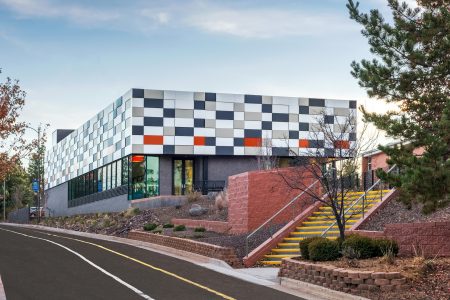
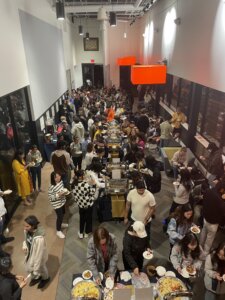
The building is modest: about 10,000 square feet, home and hosts the events of NAU’s International House and International student programming, as well as serving as a dynamic event space that can be used for events for NAU students, faculty, staff, and external organizations. It’s a place where all are welcome, with a large multi-purpose event space on the ground floor and a smaller footprint on the second floor with offices and small gathering spaces. Flexibility was the whole strategy, and a review of the events held in the building reveals a huge diversity of functions.
Part of a Longer Arc
NAU has been weaving sustainability through its curriculum since the late 1990s using the Ponderosa Model, incorporating sustainability in curricula across disciplines, and was an early signatory of the American College and University Presidents’ Climate Commitment. Early on, the university commitment that all new construction would be LEED Silver certified as part of the University’s climate commitment. It is now pursuing carbon neutrality by 2030. The International Pavilion is one visible chapter in that story — and a proof of concept the university has built on ever since.
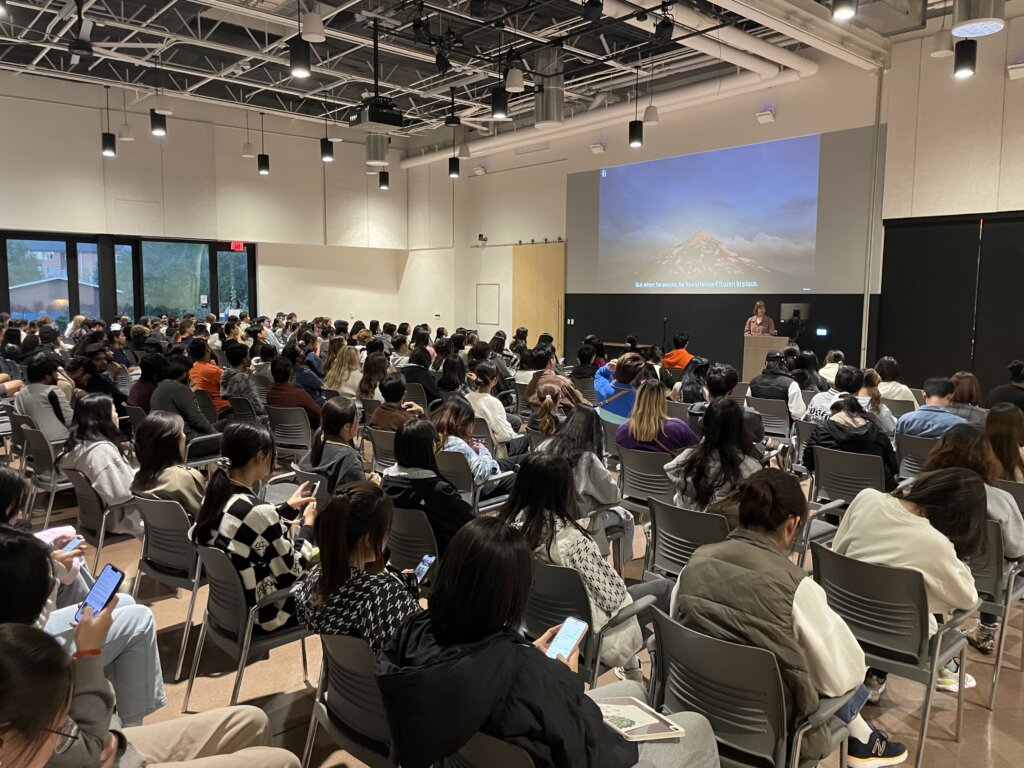
The building’s was designed to accommodate operational simplicity and flexibility, providing open-plan spaces that can be used for lectures and presentations, performances, or community events. | Photo courtesy of NAU
Designed Simply, with Intent
On Flagstaff’s high plateau, temperatures can swing 35 degrees in a single day, and the Pavilion turns that into an asset. The Pavilion has no mechanical cooling system and relies on passive cooling in the summer months and natural gas heating in the winter. Operable louvers draw in the cool night air; gravity hoods at the roof ridge let warm air rise and escape; huge ceiling fans keep air moving; and a concrete floor banks the overnight chill to coast through the afternoon. Heat comes from an underfloor radiant system, daylight from controllable solar tubes, and high clerestory glazing obviates the need for most artificial lighting. A 35-kilowatt rooftop solar array powers the building.
Per NAU’s published figures, the design uses roughly 54% less energy, 42% less indoor water, and a 100% reduction in potable water used for irrigation, using reclaimed water, when compared to a baseline conventional building — and every system is legible enough for in-house staff to understand and maintain.
The simplicity of the Pavilion’s structure and systems raises a number of important questions, especially when it comes to the day-to-day functions of an academic institution. Artificial intelligence and technology are driving new innovations in building science, and that is a good thing. But are we overstepping the virtue of easy to maintain and the simplicity of passive systems? How will we operate and manage our built assets in ten years? Twenty? Will the next generation of owners be able to maintain and operate our buildings? The International Pavilion may hold some answers.
What a Decade of Data Shows
The International Pavilion offers perhaps its greatest lesson through the data we have harvested over the years. We parsed and analyzed that data, as we would with any data set, and it reveals a number of key takeaways.
The building’s electricity demand, for example, has been small and steady, about 54 to 60 MWh per year, modest for its size but not unexpected. The rooftop solar offset a large share of it, roughly two-thirds in 2021, which is exactly what was intended. Then, in Spring 2024, on-site generation fell off a cliff: an inverter failed, likely from a lightning strike, and solar output dropped to near zero.
While it would be easy to ruminate on the Act of God tragedy of a random bolt of lightning, there are still lessons. Indeed, the randomness seems exactly the point. And the most instructive part isn’t the failure itself; it’s that the array sat dark for roughly a year before anyone realized it.
Similarly, on the heating side, which is provided by natural gas, we can see use cut by about 60% in February of 2026 thanks to a record warm, low-snow winter. Here, too, the randomness is instructive. Were these anomalies baked into the initial design calculations? Or is the better approach one that has the flexibility and agency to adapt to the atypical eventualities of operating a building in today’s unpredictable climate weirding?
The Lesson for Every Owner
A sustainable building feature you can’t maintain isn’t truly sustainable. Complex, highly technical building systems are fantastic, but they are not always the drivers of true sustainability. In this case, intentional simplicity drives sustainability. The Pavilion has aged gracefully precisely because it is modest, relies on proven passive systems, and values operational ease over system innovation.
More complex “showcase” systems in buildings elsewhere on campus have quietly degraded as institutional knowledge turned over and budgets tightened. NAU’s answer, the development of a “smart campus” using digital twins eventually for every building on campus, and occupancy-aware controls, is really about two things: knowing the moment something breaks, and having the capacity to fix it. A second lesson lands in design: weighing life-cycle operations and reliability up front, not when things break down. Or get struck by lightning.
A Story Worth Telling Now
The Pavilion matters most as proof of concept. It functions day to day as a home for NAU’s international community, and increasingly earns revenue hosting outside events. It is a showcase for the university, but a modest one that has quietly done its job over the years. And that is exactly what was intended.
Because of its location, wildfires, drought, and other complex climate shifts directly impact NAU. It also sits squarely amid the pressures reshaping higher education: from flattening enrollment, the shift toward hybrid and online learning, and the constraints on international enrollment that affect the financial model of nearly every university campus across the country. That is exactly why the story is worth telling: a credible, well-measured account of a building that works and the honesty to discuss what didn’t, is not a victory lap. Listening to the lessons our buildings whisper, and sometimes shout, is essential to our practice as architects and designers.
Download a white paper on what NAU’s International Pavilion can teach the next decade of campus design.
ABOUT THE AUTHORS